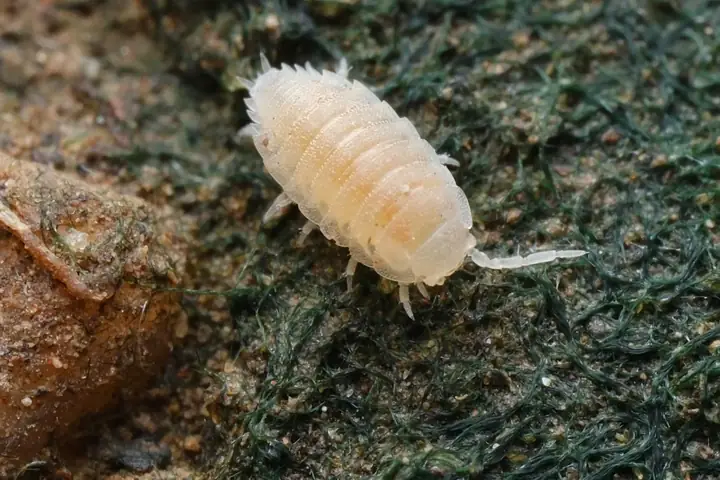
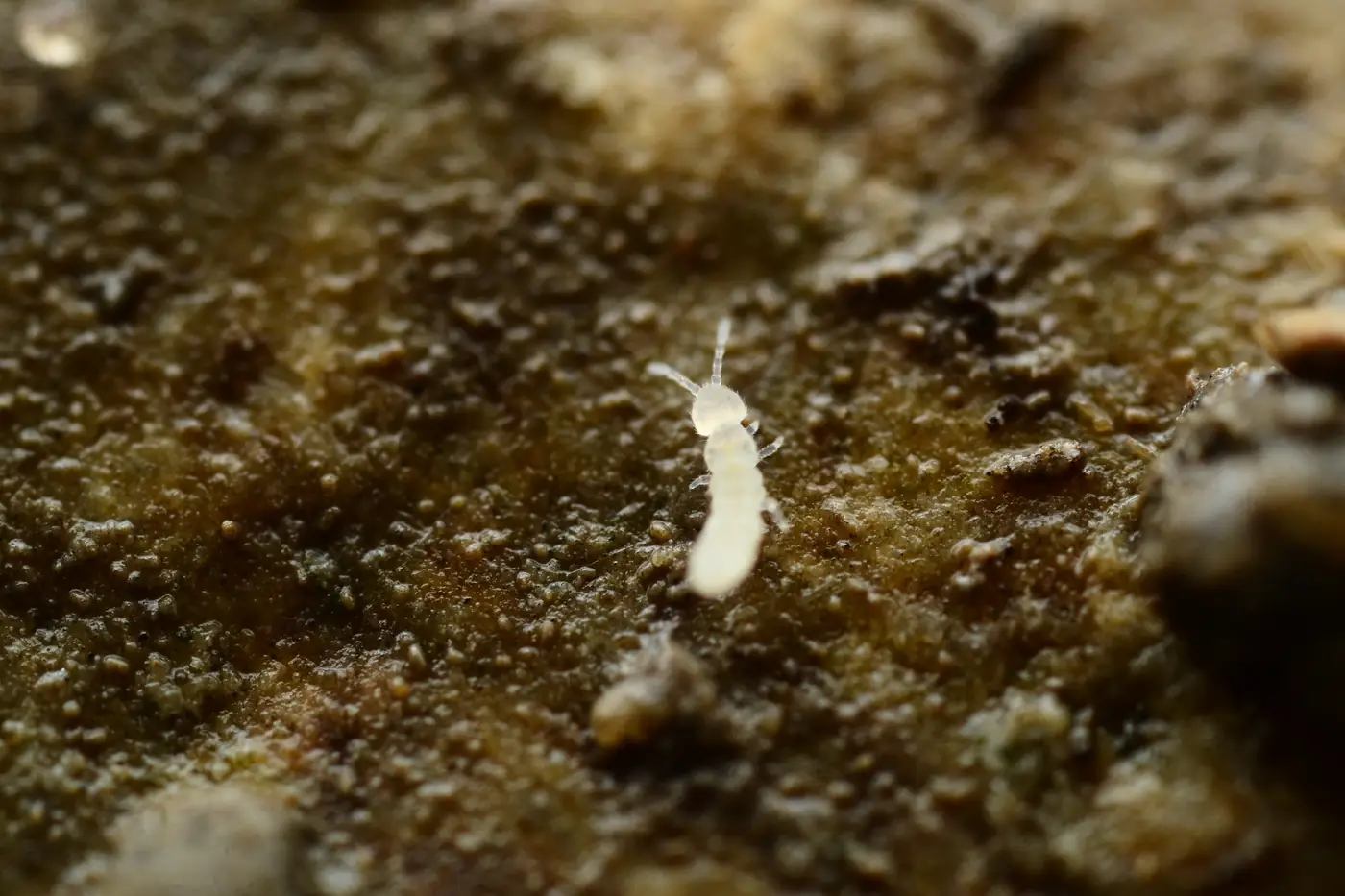
Springtails (Collembola) are six-legged soil animals, most of them only 1 to 3 mm long, that live on mold, fungi and rotting organic matter. Almost every bioactive cleanup crew relies on them, and keepers of dart frogs and spiderlings also use them as live food.
A culture costs very little to run and needs a few minutes a week. The most common pet-trade species, the temperate white springtail Folsomia candida, is so easy to rear that soil scientists use it as a standard laboratory test animal, and it reproduces without males, so a small starter is enough.
What you need
- A plastic container with a lid, around 1 to 6 quarts (1 to 6 litres). Shoebox tubs and deli cups both work.
- A substrate: natural hardwood lump charcoal, or coco fiber / organic soil.
- Dechlorinated water (tap water left out overnight, or treated with a water conditioner).
- A springtail starter culture from a reputable supplier.
- Food: active dry baker's yeast, fish flakes or rice flakes.
Charcoal or soil: which method?
Both methods work. Which suits you depends on the species and on whether you mainly want to harvest springtails or just keep a reserve going.
| Charcoal method | Soil / coco fiber method | |
|---|---|---|
| Best for | Harvesting and feeding out | Species that prefer soil, low-effort cultures |
| Harvesting | Very easy: tap off or float off | Harder: springtails mix into the substrate |
| Mites and pests | Easier to spot and control | Mites are more common |
| Food supply | Only what you add | Mold and microbes grow naturally in the soil |
| Visibility | High contrast, easy to check numbers | Harder to judge numbers |
If you're new to springtails, start with charcoal: it's cleaner, and the white animals show up clearly against the black. If they still struggle after a couple of months, split the culture and move half onto soil.
Step 1: Prepare the container
- Rinse the charcoal in a colander to remove dust. Use plain hardwood lump charcoal, never briquettes or anything sold for lighting barbecues, which can contain binders and additives.
- Fill the container about halfway with charcoal pieces. For soil or coco fiber, add 1 to 2 inches (2.5 to 5 cm), damp but not dripping.
- Add dechlorinated water. With charcoal, aim for about 1/4 to 1/2 inch (6 to 12 mm) in the bottom so the pieces above the waterline stay damp. With soil, it should feel like a wrung-out sponge with no standing water.
- Make two or three pinholes in the lid, or none at all and open it each time you feed. Springtails need humidity close to 100%.
Step 2: Add the springtails
Tip the starter culture onto the charcoal or soil. If it arrived in its own substrate, put that substrate in too, as it holds eggs and juveniles you can't see.
Add a tiny pinch of food straight away so the new arrivals have something to settle on, then close the lid.
Step 3: Feed lightly
Springtails eat the mold and microbes that grow on food more than the food itself, so a small amount lasts a long time.
A few granules of active dry baker's yeast, about what you can pinch between two fingers, is the most popular choice because springtails swarm it, but too much turns sour quickly. A crushed fish flake works too. Rice flakes or a few grains of dry rice grow mold slowly and are the gentlest option.
Feed about once a week, and check the last meal first. If food is still sitting there, skip a week.
Temperature
Springtails are happy at normal room temperature, roughly 65 to 80°F (18 to 27°C). Temperate whites prefer the cooler end; laboratory cultures of Folsomia candida are usually kept at about 68°F (20°C). Tropical species prefer the warmer end.
Keep cultures out of direct sun, which can overheat a closed container within an hour.
Keeping the culture healthy
Check the moisture weekly. A charcoal culture should always have a thin layer of water in the bottom, and a soil culture should never dry out on top.
A healthy culture smells earthy. A sour smell means too much food or stagnant water: pour off the old water, replace it, and feed less.
When the surface gets crowded, move a few chunks of charcoal or a scoop of soil into a fresh container. Running two or three cultures means one crash doesn't leave you starting from scratch. If one does crash, here is how to rescue it.
How to harvest springtails
Tapping (charcoal)
Lift a chunk of charcoal covered in springtails and tap it over the enclosure. Hundreds fall off at once.
Flooding (charcoal)
Add water until the springtails float, then pour the floating layer into the enclosure or a cup. Top the culture back up to its normal level afterwards.
Baiting (soil)
Leave a piece of bark or a slice of potato on the surface for a day or two. Springtails gather underneath, and you can move the whole piece into the enclosure.
Common problems
| Problem | Likely cause | Fix |
|---|---|---|
| Numbers dropping | Culture drying out | Add water and reduce ventilation |
| Sour smell, cloudy water | Overfeeding | Remove old food, replace water, feed less |
| Fast-moving mites | Too much food or soil-based culture | Feed less; restart a few springtails on fresh charcoal |
| Fungus gnats | Rotting food, damp soil | Feed less and keep the lid closed |
| Lots of mold but no springtails | Culture too small to keep up | Feed less until numbers recover |
Using springtails in a bioactive enclosure
Seed a new bioactive enclosure with springtails a few weeks before the animal moves in. They spread through the substrate and start on the mold straight away. One good harvest from a healthy culture is usually enough, provided the enclosure has leaf litter and a damp layer for them to live in.
Sources
- Folsomia candida, Wikipedia: biology, reproduction without males, and use as a laboratory test species.
- Fountain, M. T. and Hopkin, S. P. (2005). Folsomia candida (Collembola): a "standard" soil arthropod. Annual Review of Entomology 50.