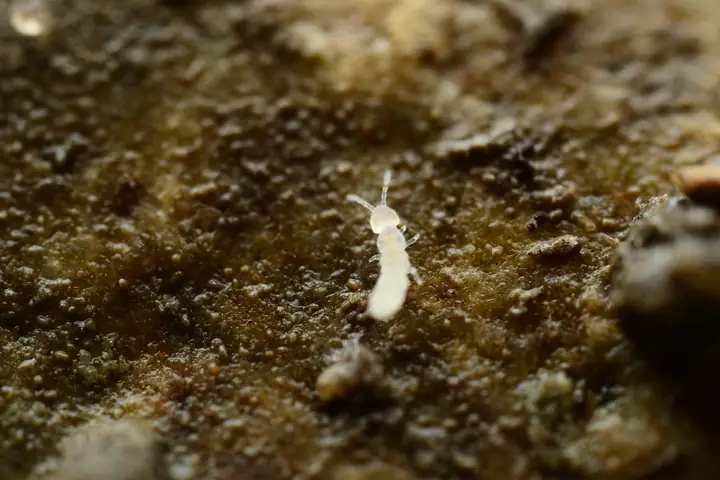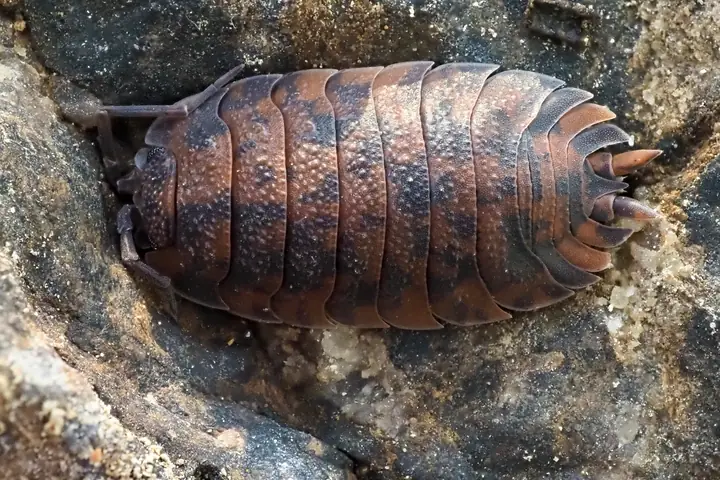
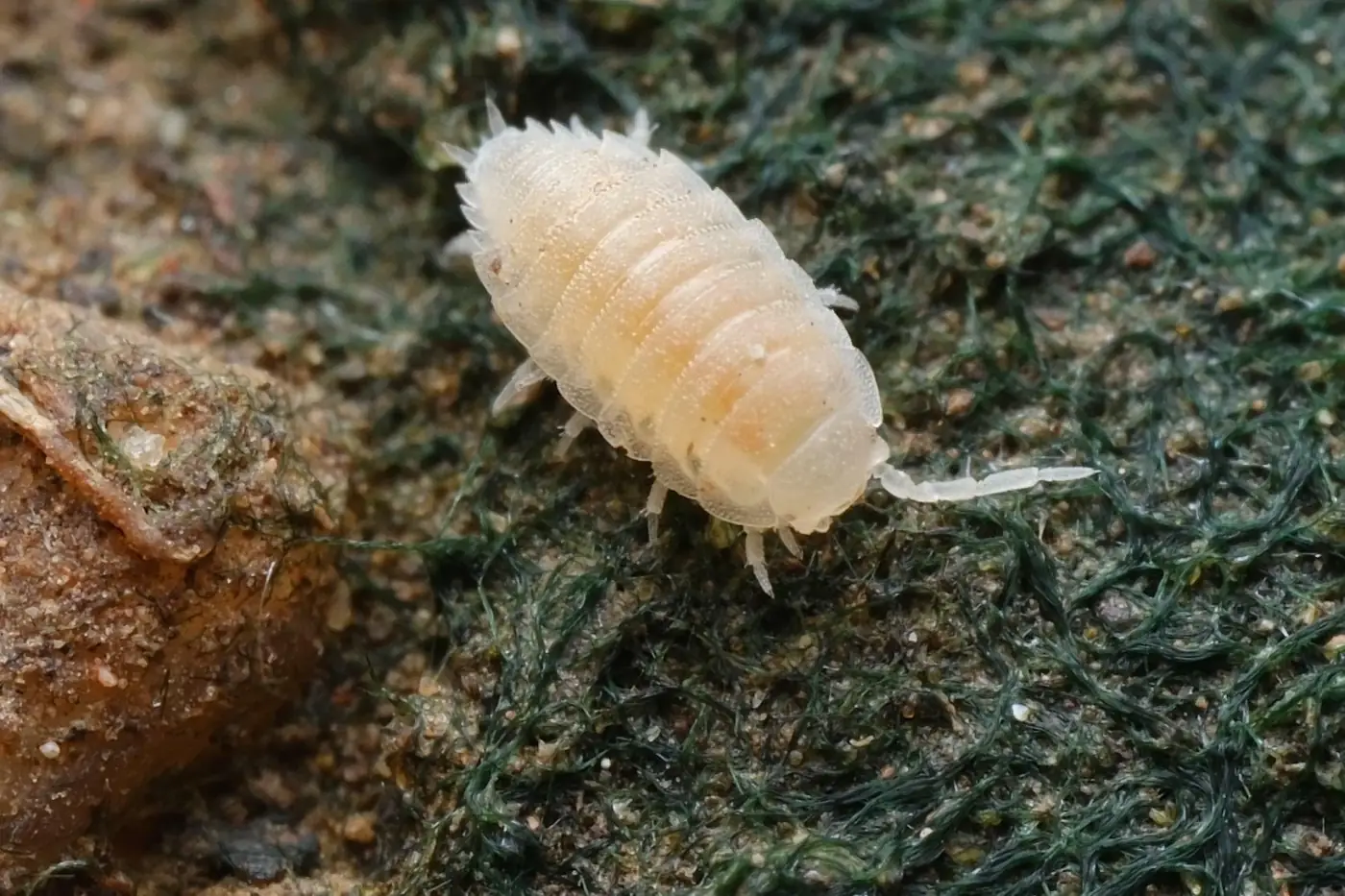
In a standard reptile or amphibian setup, you remove waste by hand and replace the substrate every so often. A bioactive enclosure uses live plants, soil microbes and a cleanup crew of small invertebrates to break most of that waste down where it falls.
Of those parts, the cleanup crew fails most often, usually because the species don't suit the enclosure or there's nothing for them to live on once the first mold is gone.
What a cleanup crew does
A cleanup crew speeds up decomposition; it won't make waste vanish overnight.
Springtails eat mold, fungi and very small particles of organic matter. New enclosures often grow a bloom of white mold on wood and soil in the first couple of weeks, and springtails are what bring it under control.
Isopods eat larger material: droppings, uneaten insects, shed skin, dead leaves and rotting wood. As they feed they also turn and loosen the top layer of soil.
Between them they keep the substrate from going sour and cut down how often you need to spot-clean. You should still pick out large droppings from bigger lizards and snakes, especially in the first few months.
Why use both
The two work at different scales. Springtails get into tiny mold patches and the gaps between soil particles, while isopods deal with bulk. An enclosure with only isopods tends to keep its mold, and one with only springtails builds up larger waste.
They rarely compete, either. Springtails are far smaller, eat different things and breed in different places, so the two live side by side without trouble.
Choosing species for your enclosure
Match the crew to the enclosure's humidity before anything else. A tropical isopod in a desert setup dries out and dies, and some desert-tolerant species struggle in a soaking rainforest build.
| Enclosure type | Examples | Good isopod choices | Springtails |
|---|---|---|---|
| Arid / semi-arid | Leopard gecko, bearded dragon | Hardy, drought-tolerant species such as Porcellionides pruinosus or Porcellio laevis | Yes, kept to a moist hide or buried moist area |
| Temperate | Corn snake, some tarantulas | Porcellio scaber, Armadillidium vulgare | Temperate white springtails |
| Tropical | Crested gecko, dart frogs, ball python | Dwarf whites (Trichorhina tomentosa), dwarf purples, powder oranges | Tropical springtails |
Small enclosures and small animals suit dwarf isopods, which stay out of sight, breed quickly and leave small frogs alone. Large, active lizards may eat a lot of isopods, so pick a fast breeder and add extra hides.
Some keepers also avoid large, protein-hungry isopod species with tarantulas and other animals that are vulnerable while molting. Smaller species, and a regular pinch of protein for the crew, lower that risk.
What the crew needs to survive
Treat the crew as a colony you are keeping, with the same basic needs as one in a tub.
Leaf litter matters most. A layer of dead hardwood leaves on the surface is both food and shelter, so top it up as it breaks down. Cork bark and wood give the crew hiding places your animal can't reach.
Keep one area permanently damp, even in a desert enclosure: under a hide, or in a lower layer of substrate. A few inches of substrate depth lets the crew move down when the surface dries, and a small piece of cuttlebone in a corner gives isopods the calcium they need for molting.
How many to add
No reliable per-gallon formula exists, and most suppliers simply recommend adding a whole culture. Good conditions matter more than the starting count, because a crew that can breed will grow to fit the space.
For a typical enclosure of 2 to 4 feet (60 to 120 cm), a common starting point is one healthy springtail culture (or a generous harvest from your own) and roughly 10 to 30 isopods, depending on species and enclosure size.
Fast breeders such as dwarf whites need fewer starters; bigger enclosures, and enclosures with animals that eat isopods, need more. If you keep your own springtail culture and isopod colony, you can top up whenever numbers look low.
When to add the cleanup crew
Add the crew after the substrate, plants and leaf litter are in, and ideally a few weeks before your animal moves in, so it can settle and start breeding before anything hunts it.
Many keepers add springtails first, to deal with the mold bloom that most new builds go through, and add isopods a week or two later.
Signs it is working
Mold appears and then fades within a week or two. Lifting leaves or bark turns up springtails, the leaf litter slowly breaks down and needs topping up, and droppings disappear faster than they used to. When you start seeing young isopods, the crew is breeding.
Common mistakes
| Mistake | What happens | Fix |
|---|---|---|
| Wrong species for the humidity | Tropical isopods dry out in arid setups | Match species to the enclosure (table above) |
| No moist zone | Isopods and springtails die off | Keep one hide or lower layer permanently damp |
| No leaf litter | The crew starves or eats plants | Keep a layer of dead hardwood leaves on top |
| Adding the animal straight away | A hungry lizard eats the crew before it breeds | Wait a few weeks after seeding |
| Expecting zero maintenance | Large waste builds up | Keep spot-cleaning big droppings |
Next steps
If you haven't already, start your own springtail culture. It costs very little and lets you reseed any enclosure in minutes instead of buying a new culture each time.
Sources
- Bioactive terrarium, Wikipedia: how plants, microbes and invertebrates break down waste in a closed enclosure.