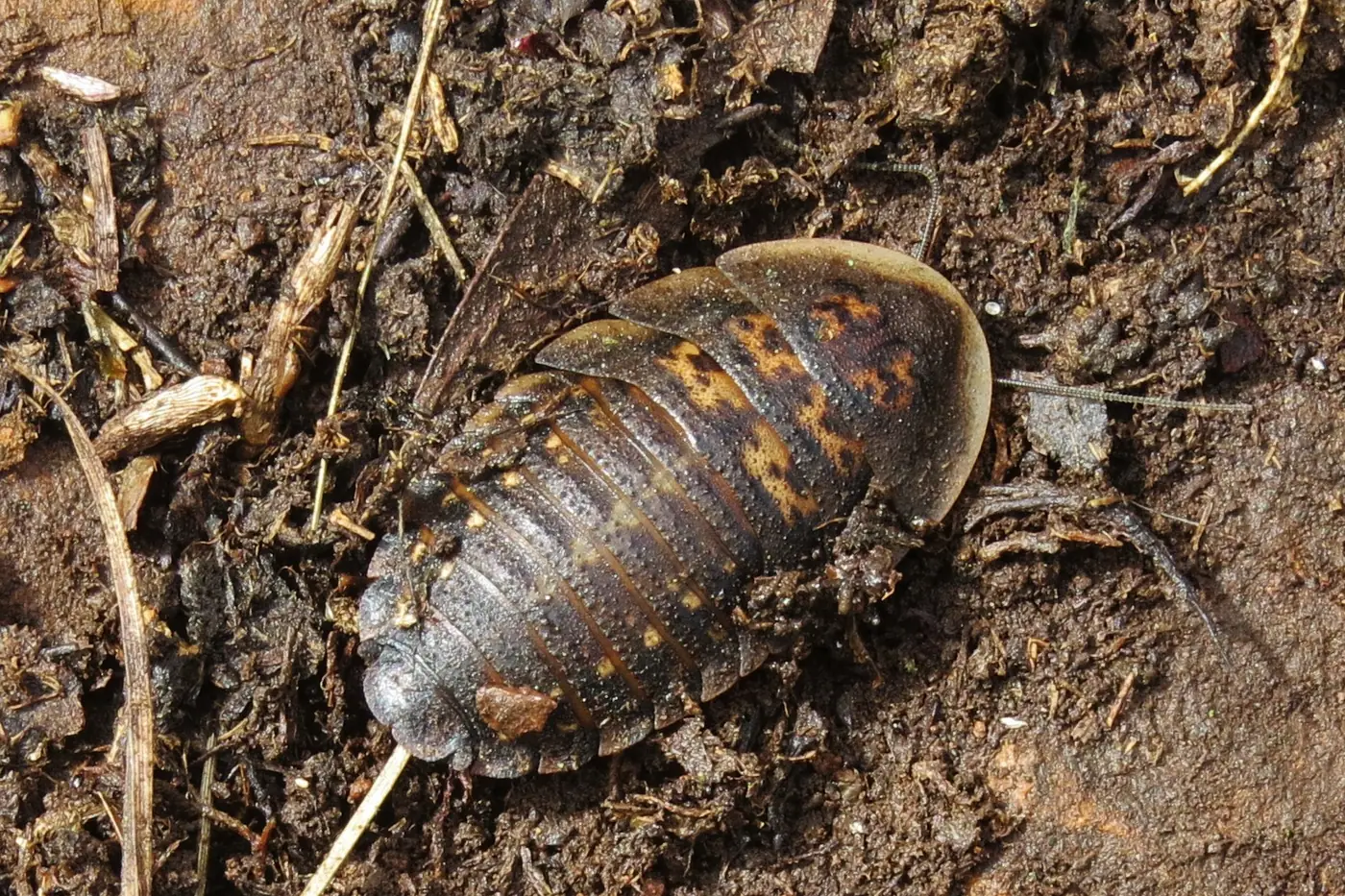
Dubia roaches (Blaptica dubia) are among the easiest feeders to breed at home. They can't climb smooth plastic, they don't chirp, and a clean colony barely smells. Once established, a single bin can keep a few lizards fed for years.
They do breed slowly compared with crickets, which is why it pays to get the setup right before you buy a starter colony.
How dubia roaches breed
Dubias don't lay egg cases you can collect. A female forms an egg case (ootheca), then pulls it back inside her body and carries it until the nymphs hatch. The nymphs are born live and are about the size of a grain of rice.
This has two practical effects:
- You can't incubate eggs separately. Breeding depends entirely on keeping adult females healthy and settled.
- Stressed females sometimes drop their egg case early. Dropped egg cases rarely hatch, so avoid disturbing the colony too often and keep conditions stable.
Nymphs take around four to six months to reach adulthood in a warm colony, and longer if kept cool. Adults are easy to sex: males have full-length wings, and females have short wing pads.
The setup
Container
A plastic storage tote of around 18 gallons (about 70 litres) is the standard starting size. It holds a starter colony of a few hundred roaches with room to grow.
Cut one or two large panels out of the lid and cover them with fine metal or fiberglass mesh, held on with hot glue or screws. Moisture from food and breathing builds up quickly in a closed tub, and damp frass leads to smell, mold and mites.
Many keepers leave the lid off entirely, because adult dubias can't climb smooth plastic. A lid with mesh is safer if you have pets or children in the house.
Egg crates
Stand cardboard egg flats upright in the bin, side by side, like files in a drawer. Vertical crates let frass fall through to the bottom instead of building up on the surfaces where the roaches live. They also give a huge amount of hiding space.
Substrate
Leave the floor bare. Substrate holds moisture, hides mites and makes cleaning harder. Frass that builds up on the bottom can be sifted out every few weeks.
Temperature
Temperature controls how fast your colony grows. Dubias are tropical, and they breed slowly or not at all at normal room temperature.
Many breeder guides recommend 85 to 95°F (29 to 35°C), but research suggests staying below the top of that range. In a 2017 study in the Journal of Economic Entomology, dubia nymphs kept at a constant 68, 77 and 86°F (20, 25 and 30°C) all developed into adults. At a constant 95°F (35°C), every nymph died before reaching the fifth stage.
A practical target is about 80 to 90°F (27 to 32°C) in the warmest part of the bin, with one side a little cooler so the roaches can move away from the heat.
A heat mat or heat cable on the side or under one end of the tub works well, as does a warm room or airing cupboard. Run any mat or cable through a thermostat; without one, the hot spot can climb far higher than you expect.
Male to female ratio
Dubia colonies need far more females than males. Too many males compete, stress the females and eat food without producing anything.
Aim for about one male for every three to five females. When the colony fills up with new adults, feed off the spare males first.
Food and water
Dry food
Keep a shallow dish of dry food in the bin at all times. Commercial roach chow, chicken feed such as chick starter, or oats mixed with a little fish flake all work.
Water
Dubias need water, but a water dish drowns nymphs. Give them moisture through fresh fruit and vegetables (orange slices, carrot, apple, squash or leafy greens), which feed them at the same time, or through a shallow dish of hydrated water crystals, which never rot.
Remove fresh food before it molds, usually within a day or two. Rotting food causes most of the smell, mold and pest problems in a dubia bin.
How many to start with
Start with as many adults as your budget allows. A starter colony of roughly 100 adult females and 25 to 30 males produces nymphs much sooner than a colony started from small nymphs, which first need months to grow up.
Plan to wait three to six months before harvesting heavily. Feeding from the colony too early is the most common reason it never takes off.
Harvesting nymphs
Lift out an egg crate and shake it over a separate tub. Pick out the size you need and return the rest. Small nymphs suit juvenile geckos and small lizards; larger nymphs suit adult bearded dragons and monitors.
Keep the breeding adults in the colony. Feed from nymphs and surplus males, and only feed adult females once the colony is producing more than you use.
A simple way to keep things tidy is to run two bins: one for breeding adults, and one "grow-out" bin where you move nymphs to grow to the size you need.
Routine care
| How often | Job |
|---|---|
| Daily or every other day | Add fresh food and remove old fresh food |
| Weekly | Check the temperature and top up dry food |
| Every few weeks | Sift frass and shed skins out of the bottom of the bin |
| Every few months | Replace soggy or heavily soiled egg crates |
Common problems
| Problem | Likely cause | Fix |
|---|---|---|
| Few or no nymphs | Too cool, too few females, or colony too new | Raise the temperature into the 80s°F and be patient |
| Adults dying | Overheating, dehydration or old age | Check the hot spot with a thermometer and offer more water |
| Dropped egg cases | Stress, disturbance or poor conditions | Disturb the colony less and keep conditions stable |
| Bad smell | Rotting food or wet frass | Remove fresh food sooner, clean out frass, add ventilation |
| Mites or flies | Excess moisture and leftover food | Dry the bin out, remove old food, sift frass |
If a colony isn't producing, check the temperature before changing anything else; a bin that sits in the low 70s°F will barely breed. The other causes are covered in why dubia roaches stop breeding.
Sources
- Wu, H., Appel, A. G. and Hu, X. P. (2017). Temperature-dependent development and thermal sensitivity of Blaptica dubia. Journal of Economic Entomology 110(2).
- Florida Department of Agriculture and Consumer Services. Guidelines for importing exotic arthropods (PDF).